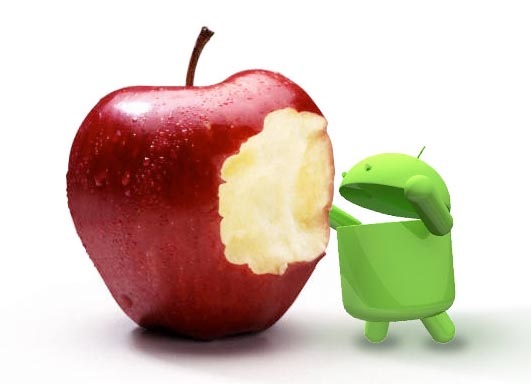
How did Google’s Android platform become the world’s number one smartphone OS? Evolution of the ''little green droid''...
By 2016 Android will power more computing devices around the world than Microsoft’s Windows software, according to Gartner. Not bad for a platform that’s only just turned five years old.
Since 2007 Android has grown and grown, then grown some more, surpassing Symbian, iOS, and RIM’s BlackBerry. But it has also contributed, along with Apple’s iOS-powered devices, to a steady reduction in the number of PC shipments per year, meaning we are now very much in a post-PC era.
The Advent of Android
Apple, Microsoft, RIM, and Nokia all had their respective ‘smartphone’ platforms well underway by the time Google released the first version of Android back in 2007. In this respect Android was very much an underdog in the developing smartphone space – it had no traction, no brand, and very few hardware partners.
At this juncture in time Symbian dominated the mobile space almost entirely, with Apple’s iOS playing the part of ‘new kid on the block.’ Then, iOS was modern and forward thinking – the physical manifestation of where the market was going.
Between 2007 and 2008 it was clear that the mobile space was at the cusp of something big. But no one could have imagined that Android would, in the space of several short years, eclipse everybody else in the space, including Apple and the then-dominant Symbian platform.
The Present Day
At the close of Q3 2012 Android controlled 68.1 per cent of the smartphone market, according to IDC, up almost 20 per cent from 46.7 per cent a year earlier. Apple’s iOS came in second place with just 26 per cent, leaving the rest – BlackBerry, Symbian, Linux, and Windows Phone – to squabble over the crumbs
So how did all this happen?
The Genesis of Android
Rumours about Google entering the smartphone space reached boiling point following the launch of Apple’s original iPhone in 2007. Many expected Google to follow Apple’s lead and release a smartphone powered by proprietary software.
This, of course, didn’t happen and Google instead chose to unveil a Linux-based open-source operating system, which it debuted in 2007 alongside the Open Handset Alliance – a collection of 86 hardware, software, and telecommunication companies devoted to advancing open standards for mobile devices.
Android Inc. circa 2003
Andy Rubin, along with Rich Miner, Nick Sears, and Chris White, founded Android Inc. in 2003 with the intention of building a class of smarter mobile device which was ‘more aware of its owner’s location and preferences.’
Android Inc. was highly secretive though and not much was known about the company, other than who its founding members were and that they ran of cash at one point. Google officially acquired the company in 2005, absorbing everything – including Rubin, Sears, and White.
Once re-located at Google, Rubin was tasked with creating a mobile phone operating system powered by the Linux kernel. It was at this point that rumours began circulating that Google was entering the mobile space, despite no one really knowing how the search-giant planned on attacking the market.
‘Google has come out of the closet at the CeBIT trade fair admitting that it is working on a mobile phone of its own,’ commented Nomura phone analyst Richard Windsor back in 2006.
He added: ‘This is not going to be a high-end device but a mass market device aimed at bringing Google to users who don’t have a PC.’
The Open Handset Alliance
Google unveiled Android on November 5, 2007. It was the first product of the Open Handset Alliance and was the start of Google’s movement towards the mobile sector.
Here’s how Google described the first iteration of Android:
‘Android is the first truly open and comprehensive platform for mobile devices. It includes an operating system, user-interface and applications — all of the software to run a mobile phone, but without the proprietary obstacles that have hindered mobile innovation,’ said Andy Rubin on the Google Blog.
The end goal of Android was described as follows: ‘through deep partnerships with carriers, device manufacturers, developers, and others, we hope to enable an open ecosystem for the mobile world by creating a standard, open mobile software platform.’
Progress was initially slow, however, and it took almost another year before the world’s first Android-powered handset, the HTC Dream, was released on October 22, 2008.
And so begins the story of Android…
What made Android so attractive to manufacturers, referred to as Google’s hardware partners, was that Android was effectively free to use. It was open-source, which meant no hefty licensing fees and no huge R&D bills – Google provided the software, manufacturers took care of the hardware. Simple.
HTC, Samsung, and Motorola were Google’s initial core hardware partners, with all three brands launching Android-powered devices in 2009. Perhaps the most well known device in the UK, however, was the HTC Hero, which launch in October of 2009.
The HTC Hero featured the following features – try not to laugh:
- Touch screen, trackball and keyboard
- Applications from the Android Market
- Google Maps, YouTube, and Google Talk
- Music downloads from Amazon.com
- Built-in Wi-Fi, 3G, and EDGE
The first 10 Android-powered handsets:
- T-Mobile G1 (HTC Dream)
- T-Mobile MyTouch 3G
- HTC Hero
- Samsung Moment
- Motorola Cliq
- Motorola Droid
- HTC Droid Eris
- Samsung Behold II
- Nexus One
- HTC Desire
At this stage in the game, circa 2009/early 2010, Samsung was something of a non-entity in the mobile space. Android had very little share of the market, but it didn’t take Google long to find its feet.
Android officially kicked off with version 1.5 (AKA Cupcake), which powered many of the above handsets, including the HTC Hero, and was the first true iteration of Android, featuring a suite of Google services.
Android 1.6 (Donut) and Android 2.0 (Éclair) appeared in the latter part of Q4 2009, bringing much-needed updates to Google’s mobile platform and its growing fleet of handsets.
In May 2010 Google pushed out Android 2.2 (Froyo) bringing multitasking to the platform for the first time. This was a big deal and considered something of a game changer because, at the time, iOS still lacked this type of functionality.
The idea behind Android, at least according to Google’s official spiel, was to introduce an open-source solution to a market completely dominated by closed-source systems like iOS, Symbian, and BlackBerry OS. It also gave the search giant another medium for generating advertising revenues.
Android: The Quickening
The uptake of Android by OEMs happened quickly with the likes of HTC, Samsung, Sony Ericsson, LG, Dell, ZTE, and Motorola pumping out tons of handsets at varying price-points between 2009 and 2011, rapidly growing Google’s share of the mobile space.
Devices like the HTC Desire, Motorola DROID, and Samsung Galaxy S popularised Android with consumers en masse and sold in the tens of millions, effectively ruining BlackBerry and Nokia’s respective smartphone businesses.
Detailing every handset that contributed towards Google’s rise to global domination is impossible. HTC was the first big player within Android thanks to the success of its HTC Hero and HTC Desire handsets, which lead to Google tasking the Taiwanese firm with building its first pure Google handset, the Nexus One.
The Nexus One was something of a flop but by this point there was another force at play within the Android Kingdom: Samsung.
Between late 2010 and 2011 Samsung’s brand and market presence grew almost as quickly as Android. It started with the Galaxy S and climaxed in early 2012 when Samsung surpassed Nokia as the world’s biggest handset manufacturer.
But it was the rate of adoption and the availability of Android that made the platform so popular. It’d be impossible to detail the exact specifics of Android’s growth over the years – there are simply too many contributing factors.
Fortunately, Google has published a video showing Android adoption between 2008 and 2011, which you can see below:
Present Day: 2012
As of Q3 2012, upwards of 75 per cent of all smartphones shipped are powered by Google’s Android platform. That’s literally billions of devices, and Google is showing no signs of slowing down anytime soon, releasing at least two updates to Android a year.
Samsung, HTC, and Google are constantly pushing the boundaries of what’s possible with mobile devices.
There is a lot of competition in the space from the likes of Apple, with its range of iOS-powered iPhones and iPads, and Microsoft’s new Windows Phone and Windows 8 systems.
But, the bulk of the competition within the market isn’t really between opposing platforms: it’s between Android manufacturers like HTC and Samsung.
In this sense, Apple is niche compared to Android – and it looks set to stay that way for the foreseeable future.
Yep, Microsoft, Apple, BlackBerry, and whoever else wants a pop at the mobile space will have yo play second fiddle to Google’s Android platform, which is almost now too big to fail.
The next five years should be very interesting, indeed. And while Google’s Android will undoubtedly remain top of the pile, there are some things we’d like to see ironed out of the platform, such as fragmentation and the fact that many of Google’s services – Google Music, for instance – aren’t available outside the US.
Courtesy: Mobogenie